Spring Branch ISD JROTC Showcase Hard Work
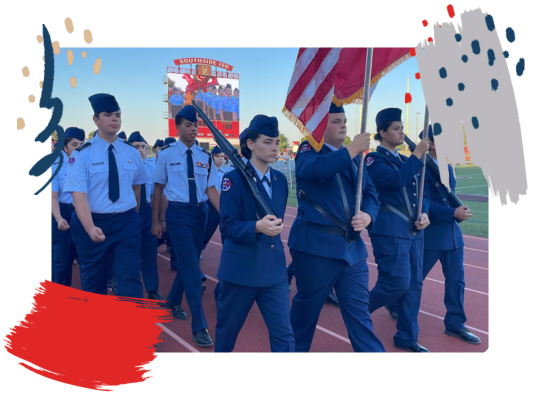
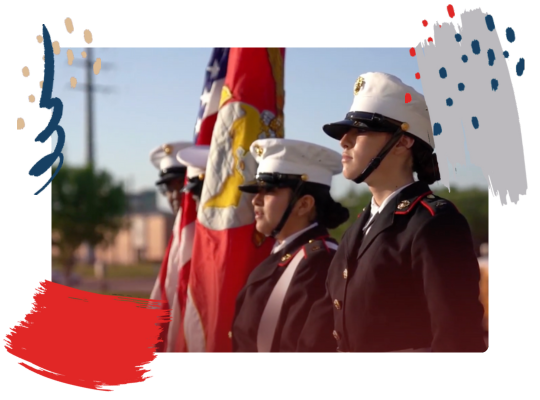
Spring Branch ISD JROTC students completed their annual inspection at the Guthrie Center, showcasing their dedication and hard work. NJROTC cadets participate in several outside,
Find Texas Schools and Independent School Districts
ROTC is the Reserve Officers’ Training Corps, a military training program for students enrolled in college. JROTC is the Junior Reserve Officers’ Training Corps, the same training program as the ROTC but geared towards high school students.
The JROTC program operates in more than 1,700 high schools, military institutions, and correctional centers throughout the United States and overseas. It serves 314,000 JROTC Cadets annually.
Approximately 40% of JROTC programs are in inner-city schools, serving 50% of minority students in those schools. Female Cadets make up 40% of the Cadet population.
The JROTC’s mission is “To Motivate Young People to be Better Citizens”.
JROTC cadets gain a sense of home, family, and country. JROTC cadets build skills such as leadership, self-confidence, and discipline, as well as personal skills like health, nutrition, and financial management.
JROTC is a high school elective program that teaches cadets leadership, geography, civics, health, global awareness, life skills, and U.S. history. Cadets learn to collaborate, reflect, develop critical thinking skills, and integrate content with other disciplines.
JROTC programs are funded by the Department of Defense and taught by retired service members. Course content includes branch-specific military history and customs. Cadets wear uniforms corresponding to the uniforms worn by military personnel in their respective branches. Cadets wear a JROTC uniform once a week and at JROTC-sponsored events. They take part in physical fitness training and marching drills.
JROTC cadets are assigned ranks comparable to their corresponding military branch. After cadets gain military knowledge and leadership skills, they can advance in their ranks.
Joining the Junior Reserve Officer Training Corps program offers a wide range of benefits for students, including:
Leadership Skills: JROTC programs develop leadership qualities like communication, time management, problem-solving, and decision-making.
Teamwork and Camaraderie: JROTC emphasizes a sense of teamwork and camaraderie among participants, building strong relationships and a supportive environment.
Physical Fitness: JROTC programs highlight physical fitness and offer training in physical activities, such as running, calisthenics, and marching, leading to better overall wellness.
Discipline and Responsibility: JROTC programs teach discipline, responsibility, and accountability, developing self-control and self-esteem.
Scholarship Opportunities: JROTC programs offer scholarship opportunities for students pursuing higher education.
Career Opportunities: JROTC provides students with opportunities in different career paths to develop skills in a variety of professions, including jobs in the military.
Patriotism and Citizenship: JROTC programs instill a sense of patriotism and civic responsibility in students, leading to a greater understanding and appreciation of our country and its institutions.
Studies have shown that there are several positive academic and non-academic benefits of participation in JROTC. A Rand report showed that there were positive associations between GPA and JROTC participation. Students who were part of a JROTC unit were less likely to drop out of high school and attend classes more frequently. JROTC cadets have a stronger sense of community and can pursue military jobs through ROTC scholarships and service academies. College admissions counselors also value JROTC experience on applications.
JROTC is a program that can benefit a wide range of students. Any student interested in developing leadership skills, learning about military history and national defense, improving physical fitness, and developing life skills can join JROTC.
JROTC can be particularly beneficial for students who are interested in pursuing a career in the military, but it is not a requirement for joining the program.
Cadets in a JROTC unit are not required to join the military after high school. However, participation in the JROTC program may improve a cadet’s rank upon enlisting in the military. JROTC gives them an edge during military training.
College scholarships for high school JROTC students include college credits for completing the JROTC program. Visit College Options Foundation or Go Army for more details.
The ASVAB is the Armed Services Vocational Aptitude Battery test. The ASVAB is a multiple-choice test used to determine an individual’s qualifications for military enlistment. The test measures knowledge in areas such as math, science, reading comprehension, and mechanical knowledge, as well as vocational aptitudes relevant to military service. Students may take the ASVAB as early as 10th grade, but most high school students take the test in their junior or senior year. ASVAB scores can be used for enlistment up to two years after you take the test.
JROTC (Junior Reserve Officers’ Training Corps) is a high school leadership development program offered through public schools. It focuses on building citizenship, leadership skills, discipline, and personal responsibility in students.
The purpose of JROTC is to help students develop strong leadership abilities, good citizenship, and personal character. The program is designed to prepare students for success in college, careers, and life, not just military pathways.
No. A key point of JROTC is that students are NOT required to join the military after completing the program. Participation is focused on education and leadership development, not military enlistment.
Students in JROTC learn important life and leadership skills, including:
These skills are designed to support both academic success and future career readiness.
JROTC is a military-sponsored educational program, but it is taught within public schools as part of the academic curriculum. It is not active military service and does not involve enlistment.
JROTC is typically taken as a regular elective class during the school day. Instruction may include classroom learning, leadership exercises, structured activities, and team-based development experiences.
Yes. Students in JROTC typically wear a standardized uniform as part of the program. This helps reinforce discipline, structure, and professionalism.
JROTC programs are available to students enrolled in participating public high schools, depending on whether the program is offered on that campus.
Yes. JROTC is part of the public school system and is generally offered at no cost to students.
Students gain long-term transferable skills, including:
These skills are useful in college, careers, and everyday life.
JROTC prepares students by building strong leadership habits, communication skills, and personal accountability, all of which are valued in higher education and the workforce.
Students join JROTC to gain leadership experience, structured learning opportunities, and personal development skills in a supportive school environment.

Fort Bend ISD’s JROTC hosts the annual Pass-In-Review, which is a long-standing tradition within the military that allows units to parade in dress uniform before their Commander. The event includes drills performed by cadets from 11 high schools, recognition of the graduating seniors, and military song performances by high school bands.

Spring Branch ISD JROTC students completed their annual inspection at the Guthrie Center, showcasing their dedication and hard work. NJROTC cadets participate in several outside,

The Harlandale Memorial Monument was built in September 1971 to recognize the fallen Harlandale ISD students that were drafted into the United States Armed Forces

Cleveland High School’s AFJROTC unit proudly presented the colors at the Texas Soccer Showdown between rivals Houston Dynamo and FC Dallas. This event not only
If you want to take advantage of this benefit or learn more about how a membership can help your organization please click the button below.